Women Workers in the First World War by Gail Braybon
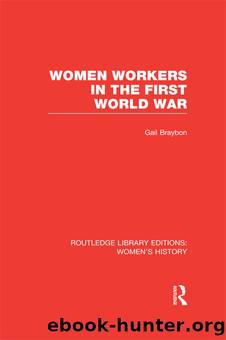
Author:Gail Braybon [Braybon, Gail]
Language: eng
Format: epub
Tags: History, Modern, 20th Century, Social History
ISBN: 9780415622707
Google: K_4nFf0xFk8C
Publisher: Routledge
Published: 2012-10-09T15:54:56+00:00
The Government and Welfare
Much of the book so far has been concerned with the interaction of sexist ideology and capitalism. Many employers stated that they would not employ married women, yet they accepted that wives who were laid off would find less well paid work with other employers, and that this system kept womenâs wages down, with all the adverse effects on womenâs health and family life such wages had. Trade unionists said that they did not want their wives to work, and accepted that their daughters would be paid less than their sons, yet blamed women in general for accepting low wages and remaining a danger to men. The situation becomes even more complex when one considers the role of the government in the field of welfare during the war. For although the government was certainly no ally to labour, and had indeed become an employer in its own right, its motives and aims were not the same as those of other employers. The government had to consider its own image with voters, take account of pressure from labour politicians, consider national efficiency and racial health (widespread ill health is expensive once the state is paying sickness benefit), none of which were issues which concerned capitalists, and, in addition, many of those experts who advised government, or sat on its committees, by no means approved of the standard capitalist approach to labour.
The government was fighting a war, and it was essential that labour be used efficiently in the munitions industry at least. But there were differences in the concept of efficiency. Some employers wanted the right to work their employees for as long as they thought necessary, clearly assuming that this was efficient use of labour. It was up to the government to show them that it was not, and that shorter hours and better working conditions led to higher output. Yet the research which dealt with the beneficial effects of factory welfare schemes was also concerned with the techniques of âscientific managementâ, which included reorganisation of factory layout, the accurate timing of jobs and the subdivision of processes for the purpose of mass production, all of which were anathema to trade unionists, and also, importantly, still viewed with cynicism by many employers at this time. Was it âbetterâ for workers to work in a clean modern factory, with good ventilation, subsidised canteens and welfare officers, for shorter hours, or in a cramped dirty factory, with few safety regulations, and nowhere to eat meals, for a day which was far too long, but involved more skilled or interesting work? This, basically, was the choice as many saw it. In fact, both involve the exploitation of the worker; the former means monotonous work and close supervision; the latter means scant regard for safety or comfort. There are discussions still about whether âwelfareâ in all its forms (state benefits, employment protection, factory legislation) is necessary as protection for the workers instigated by the state, or whether it involves unacceptable interference with
Download
This site does not store any files on its server. We only index and link to content provided by other sites. Please contact the content providers to delete copyright contents if any and email us, we'll remove relevant links or contents immediately.
The Vikings: Conquering England, France, and Ireland by Wernick Robert(84385)
Ali Pasha, Lion of Ioannina by Eugenia Russell & Eugenia Russell(40321)
The Conquerors (The Winning of America Series Book 3) by Eckert Allan W(37990)
The Vikings: Discoverers of a New World by Wernick Robert(37008)
Cecilia; Or, Memoirs of an Heiress — Volume 1 by Fanny Burney(32639)
Cecilia; Or, Memoirs of an Heiress — Volume 2 by Fanny Burney(32013)
Cecilia; Or, Memoirs of an Heiress — Volume 3 by Fanny Burney(31997)
Empire of the Sikhs by Patwant Singh(23138)
The Secret History by Donna Tartt(19312)
Hans Sturm: A Soldier's Odyssey on the Eastern Front by Gordon Williamson(18653)
Cat's cradle by Kurt Vonnegut(15446)
Pimp by Iceberg Slim(14687)
Sapiens: A Brief History of Humankind by Yuval Noah Harari(14467)
Norse Mythology by Gaiman Neil(13460)
Talking to Strangers by Malcolm Gladwell(13448)
Leonardo da Vinci by Walter Isaacson(13414)
4 3 2 1: A Novel by Paul Auster(12520)
Underground: A Human History of the Worlds Beneath Our Feet by Will Hunt(12149)
The Radium Girls by Kate Moore(12097)
